
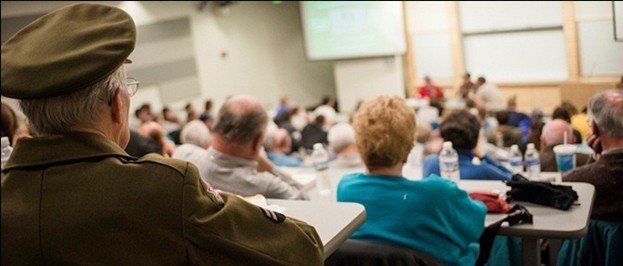
‘Wartime Stories’
When you choose to become a soldier, you know it means that your life will be in grave danger. Dying doesn’t only happen in actual combat or battlefield but also in training. You have to undergo rigorous training that will test your physical, mental, and psychological abilities. But if you are not a soldier you can only imagine what experiences they have went through, which is far from the reality of living them.
Regis College are holding a history course and free public speaker series entitled as “Stories from Wartime”. Every Thursday, veterans who had first-hand experience of wars from World War II, Afghanistan, and up to Iraq attend this event. During this time, they are narrating their memories and sharing how their experiences changed their lives. With the help of this event, students are able to see the personal side of war that textbooks can’t offer.
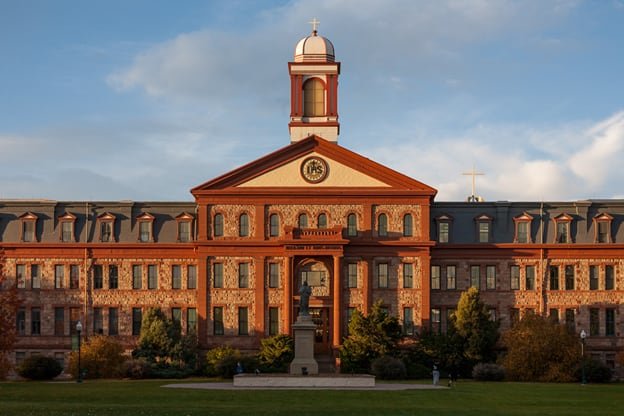
The Regis’ Center for the Study of War Experience has been holding this event for 22 years. They have an extensive collection of items, written testimonies, and videotapes that help describe the lives of more than 150 American veterans during wartime. Thus, it is recognized by the country as a source of personal war narratives and testimonies.
This year, the university launched the event in late January and will keep it going until April 25. It was organized by Professor Nate Matlock and will feature veterans from World War II, Vietnam, Korea, and Iraq. According to him, the main goal of the “Stories from Wartime” is to make citizens understand the experience of an individual in a real conflict.
“About 1 percent of the population ever serves in uniform, and only a small fraction of those people ever see a shot fired in anger. And so I think it’s very important for people who have done the nation’s fighting to be in dialogue with members of the community and with the public so everybody can have some better understanding of what’s done in our name, how it’s done, and we can make informed decisions about when we’re going to commit to a course of violence.” – Professor Matlock
The first-panel discussion happened on January 31 with five veterans who shared their stories during their duties and after they left the military service. There are several veterans who shared different experiences from suffering PTSD, insomnia, shifting moods, taking medications, as well as struggles of being a woman in the battlefield.
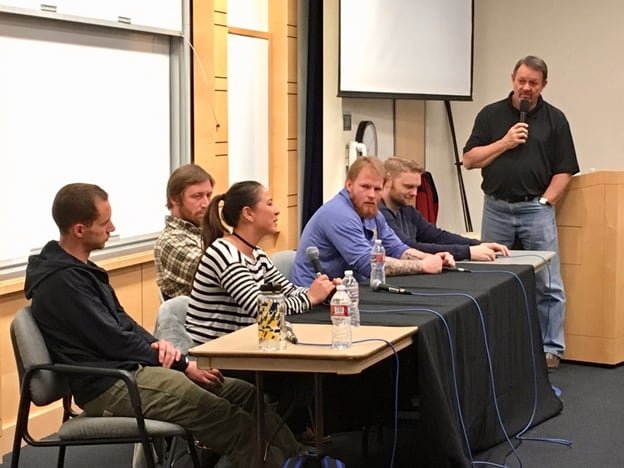
In U.S. Marine David Pond’s case, who retired in 2011 and was ‘mentally broken’ – he suffered from mood swings and difficulty in sleeping. During the dark times of his life, he sought out the K-9 dog who served with him during his seven months in Afghanistan. When they both left the military, they were split up; Pond went back to Colorado while the Belgian Malinois was put in stateside assignments. It took him five years to finally be reunited with Pablo, which greatly helped him deal with his post-deployment experiences.
“I just realized I needed my dog. I needed my Marine back. My reasons were just. If you knew me, you’d say ‘OK.’” – U.S. Marine David Pond
On the other hand, U.S. Army sniper Garett Reppenhagen was deployed to Iraq in the 1st Infantry Division back in 2005. In his opinion, all veterans have ‘some hyper-vigilance with some sounds’. However, in his case, it is his sense of smell that is highly sensitive nowadays. There are certain smells of things like a tea, diesel, or burning trash that reminds him of his times in Iraq. In Reppenhagen’s case, it is a sign of PTSD or post traumatic stress disorder which happens when a person experienced a traumatic incident. Based on the data from the U.S. Department of Veterans Affairs, there are a number of veterans who suffer from PTSD including veterans from the Vietnam and Gulf Wars, as well as Operations Iraqi Freedom and Enduring Freedom.
There are several other stories that war veterans can share with other citizens. Their experiences differ from one another, so we can definitely learn plenty of things from them. With the help of this event, both veterans and citizens can help each other. Veterans are able to voice out their experiences, what can greatly help them with their combat traumas. They have more courage to speak up because they know that there are people who are willing to listen to their stories. On the other hand, citizens will be able to receive first-hand information on what is happening during wartime and appreciate the efforts of every soldier who are risking their lives to serve the country.
More inOpen Your Mind
-
`
 5 Powerful Reasons Why You Should Manifest Right After Waking
Manifesting immediately after waking seems almost too easy, but there’s real power in this quiet moment. Your mind is fresh, open,...
February 5, 2026 -
`
 Here’s How ‘Snack Tourism’ is Transforming Travel Adventures
Travel used to mean landmarks, museums, and photo stops that all looked the same after a while. Now it looks more...
January 31, 2026 -
`
 How You Can Find Love in Ireland’s Century-Old Singles Festival
If dating apps have drained your energy, you are not alone. Swiping, ghosting, and forced small talk can make love feel...
January 24, 2026 -
`
 This Unique, Pacifist Ethiopian Community is Preaching Peace Amid the Amhara Conflict
High in Ethiopia’s Amhara highlands sits Arwa Amba, a village that runs on calm when chaos surrounds it. About 500 to...
January 17, 2026 -
`
 How to Remain Calm in Anxious Times? A 3-Step Framework That Always Works
Anxiety shows up fast. Your chest tightens, and your thoughts race. The world feels loud and heavy all at once. When...
January 11, 2026 -
`
 Oreo Introduces 9 New Holiday Flavor Varieties Just in Time
The holidays are louder, sweeter, and way more fun when cookies get involved. This year, Oreo is making this holiday season...
January 2, 2026 -
`
 Greece is the Best Country to Retire in 2026, Latest Retirement Index Reveals
Greece just pulled off a quiet upset. According to the 2026 Annual Global Retirement Index, it now ranks as the best...
December 26, 2025 -
`
 President Trump’s Operation Metro Surge Begins in Minneapolis and St. Paul
Operation Metro Surge rolled into Minneapolis and St. Paul during the first week of December 2025. ICE brought in about one...
December 18, 2025 -
`
 Psychologist vs. Psychiatrist: Which One Should You Choose?
Choosing the right mental health professional can feel confusing. The names sound similar, but the roles are very different. Once you...
December 13, 2025
More From MilitaryBud
-
 Why Most People Aren’t Open-minded As They Claim to Be
Ask people if they are open-minded, and most will answer with a confident yes. Few individuals see themselves as stubborn, biased,...
Open Your MindJune 25, 2026 -
 All the Reasons Why Darjeeling Tea, the “Champagne of Teas,” is So Popular Around the World
Few teas enjoy the kind of reputation that Darjeeling Tea has earned. Grown in the hills of India’s eastern Himalayas, this...
Food AdventuresJune 18, 2026 -
 How the Internet Has Given Birth to the Rising Coffee Culture? A Closer Look
Coffee is no longer just a way to wake up in the morning. It has become a lifestyle, a social activity,...
LifestyleJune 11, 2026 -
 Aledo Community Grieves a 14-YO Student Killed on His ATV the Night Before Middle School Graduation
Aledo, Texas, is grappling with an unimaginable loss after the death of 14-year-old Brayden Martin. The eighth-grade student at Aledo Middle...
CommunityJune 3, 2026 -
 Self-talk Makes You Who You Are – Be Mindful of What You Tell Yourself!
You talk to yourself all day long. Most of the time, you do not even notice it. That running voice in...
Open Your MindMay 28, 2026
You must be logged in to post a comment Login